
Forté IQ
Power as the New Currency
Navigating the Data Center Energy Crisis
Pranay Kashyap, Marketing Specialist
07:13, 06 February 2026
Generative AI
The revolutionary surge of Generative AI (GenAI) and its foundational requirement for massive computational power is pushing data center energy consumption into unprecedented territory. Projections suggest this consumption could realistically double or triple by 2030. In this new, resource-constrained environment, access to reliable, high-capacity electrical power has become the single most critical asset, it is the new currency of the digital economy and the ultimate determinant of technological growth.
The revolutionary surge of Generative AI (GenAI) and its foundational requirement for massive computational power is pushing data center energy consumption into unprecedented territory.
The Core Driver
The Core Driver: The AI Tsunami and the Watt Density Crisis
The exponential scaling of AI models (e.g., large language models) and High-Performance Computing (HPC) is the main catalyst, fundamentally altering the physics of a data center rack.
- The Accelerator Tax: The Physics of AI: AI systems rely on specialized hardware, primarily GPUs and TPUs,which are fundamentally power-hungry. The Thermal Design Power (TDP) for modern accelerator chips consistently exceeds 300W to 700W per chip. A standard server for deep learning may house eight such accelerators, pushing a single 2U server's draw well beyond 3,000W. This translates to an entire rack easily drawing 50kW to 100kW, compared to the historical average of 8kW to 15kW for enterprise racks. This dramatic increase in watt density strains existing infrastructure to the breaking point.
- The Time Lag: Supply Mismatch: The bottleneck is not capital; it is time. Data center facilities themselves can be built in a relatively quick 18 to 24 months. However, securing new utility generation assets (like gas or solar farms) and the necessary substation and transmission line upgrades often takes a protracted five to seven years. This fundamental mismatch in construction timelines creates an unbridgeable supply bottleneck in constrained Tier 1 markets.
- The Global Scale of the Demand: The demand shock is global. In the US, estimates from the Electric Power Research Institute suggest that data center load growth could account for up to 90% of all new commercial/industrial electricity demand over the next five years. This scale is forcing regulators and utility providers to fundamentally rethink grid planning.

Grid Scarcity
Grid Scarcity: The Siting Bottleneck
In major hyper-scale hubs, from Northern Virginia (Data Center Alley) to Dublin, Ireland, and West London, the crisis manifests as multi-year connection backlogs. Utility companies are simply unable to commission the necessary infrastructure at the pace required by cloud providers.
- The Siting as Strategy Mandate: This scarcity has made "Siting as Strategy" mandatory. The most valuable land is no longer the cheapest or the most fiber-rich; it is the land with immediate, available megawatt capacity. This has led to a significant shift in development, where companies are forced into "power-first" development in non-traditional, often secondary or tertiary, markets where grid capacity is still available, such as central Ohio, parts of the Mountain West, and certain Scandinavian regions.
- Stranded Power Capacity: Even in existing facilities, the inability to get more power means that companies are now analyzing their leased space for "stranded capacity" unused power headroom in old racks,to cram in new, more powerful AI hardware, maximizing the use of every available amp.

The New Business Mandates
The New Business Mandates: Two Fundamental Shifts
The centrality of power is driving two fundamental, and costly, shifts in data center strategy and operation.
1. Extreme Efficiency is Non-Negotiable
Every single watt must be scrutinized and optimized. Power density limits have made efficiency a survival mechanism.
-
The PUE Imperative: The End of Legacy Cooling: The industry standard metric, Power Usage Effectiveness (PUE), must aggressively trend toward the theoretical ideal of 1.0. A data center with a PUE above 1.3 is now considered functionally obsolete for high-density AI deployments. The focus has moved beyond optimizing HVAC and chiller plants to eliminating wasteful intermediate steps entirely.
-
Liquid Cooling Adoption: From Niche to Mandatory: Advanced cooling methods are no longer optional extras but required technology for high-density builds:
-
Direct-to-Chip (DTC) Cooling: This method uses cold plates directly on the CPU/GPU, removing heat much closer to the source. It significantly reduces the load on the facility’s air-based Computer Room Air Handler (CRAH) units.
-
Immersion Cooling (Single- and Two-Phase): Submerging servers in a non-conductive dielectric fluid can remove up to 100kW per rack, a four to five fold increase over traditional air cooling. This drastically reduces facility cooling energy consumption (the "C" in PUE) and allows for unprecedented compute density.
- Software-Defined Power Management: Beyond hardware, new AI-driven software is being deployed to dynamically manage power draw. These systems can learn and predict workload demands, throttling power to components that are temporarily idle to ensure a server never unnecessarily draws its maximum configured power cap.
2. Power Generation is Integrated
Relying solely on the strained utility grid is too great a risk. Data centers are evolving beyond being passive energy consumers into active, integrated energy hubs in essence, becoming their own micro-utilities.
-
On-Site Generation: Bypassing the Delays: Developers are increasingly exploring dedicated, on-site solutions to bypass multi-year utility connection delays. This includes commissioning modular natural gas plants or high-capacity fuel cells (using natural gas or biogas). These micro-grids provide immediate, reliable power capacity,albeit with added complexity regarding emissions and long-term fuel costs.
-
Hybrid Energy Systems for CFE: The demand for 24/7 Carbon-Free Energy (CFE) is pushing a deeper integration of renewable energy assets:
-
Battery Energy Storage Systems (BESS): Large-scale battery farms are becoming standard complements.They smooth out power spikes, provide critical, immediate backup power, and, crucially, allow the data center to store energy purchased from renewable Power Purchase Agreements (PPAs) when the sun is shining or the wind is blowing. This ensures continuous, reliable operation and helps stabilize the local grid by providing ancillary services.
Conclusion: The New Metric of Success
The age of cheap, readily available power for data centers is over. Power is the new constraint, the new cost center, and the new competitive advantage.
Market leadership is no longer solely dictated by processing speed or latency; it is dictated by the ability to secure, provision, and utilize megawatts efficiently. The strategic battleground has shifted from the silicon factory floor to the utility interconnection point. Companies that master this energy paradigm integrating generation, deploying extreme efficiency, and maximizing compute per watt, will be the ones that own the AI future.
The age of cheap, readily available power for data centers is over
Further Reading
Related insights
Expert analysis, market trends, and professional guidance from the world's leading data center specialists.
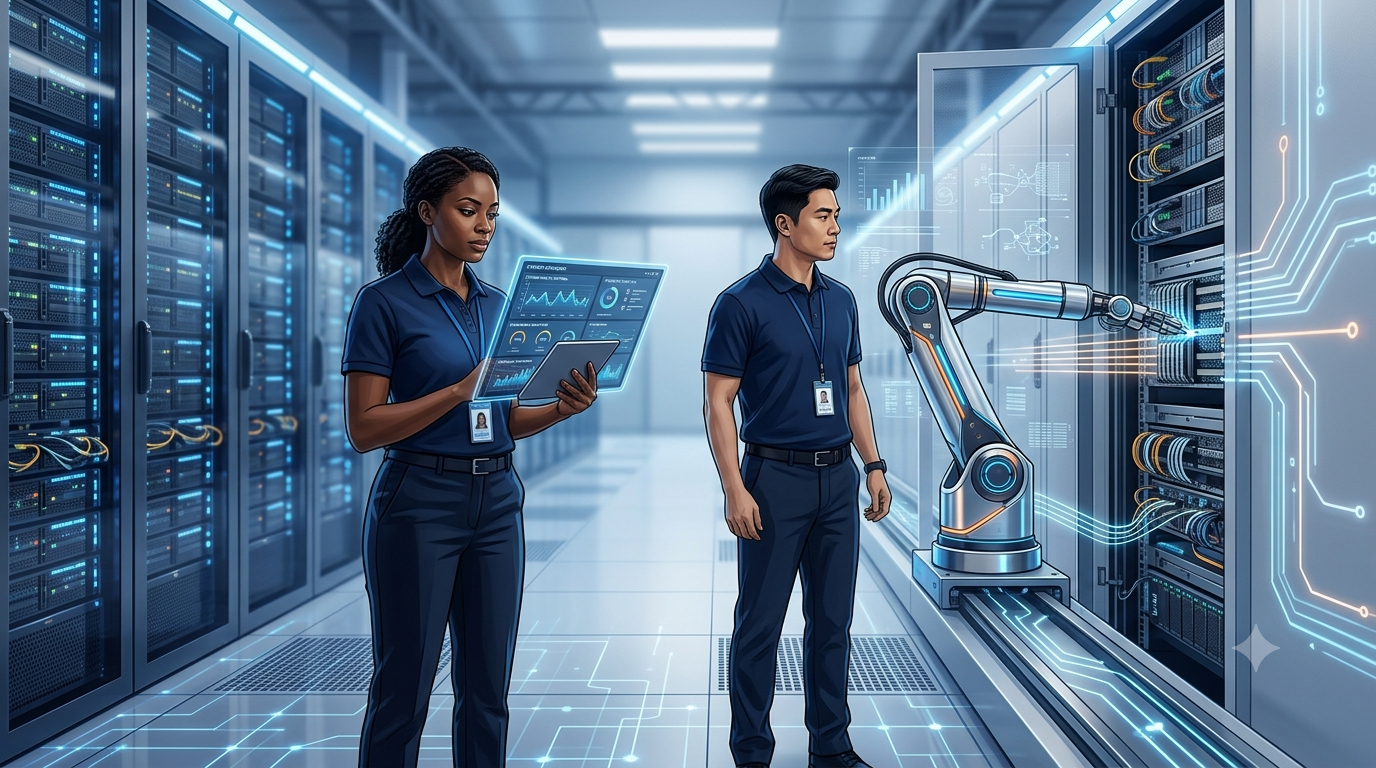
Why Automation Is Reshaping Modern Data Center Roles
Adapting to Change: The New Skills and Roles Emerging as Data Centers Embrace Automation
Mainak Poddar, Marketing Specialist
High Demand Data Center Careers for Future Professionals
Why the data center industry may be the most overlooked career opportunity of our time.
Mainak Poddar, Marketing Specialist
How AI Is Creating New Data Center Career Options
AI is expanding the scope of infrastructure roles — creating specialist opportunities that barely existed three years ago.
Mainak Poddar, Marketing Specialist
Explore All Further Reading
Access comprehensive expert analysis, real-time market intelligence, actionable career guidance, and in-depth technical insights from DC Forté's global community of data center specialists, industry thought leaders, and Advisory Board members. New insights published weekly across careers, technology, market trends, and sustainability topics.
Ready to Lead, Not Follow?
Join the professionals who read it on Forté IQ first.
Trusted by 150,000+ data center professionals worldwide